
Design Intelligence #18: Water ways
Redesigning the city - and our relationship with water - to open up different ways of living

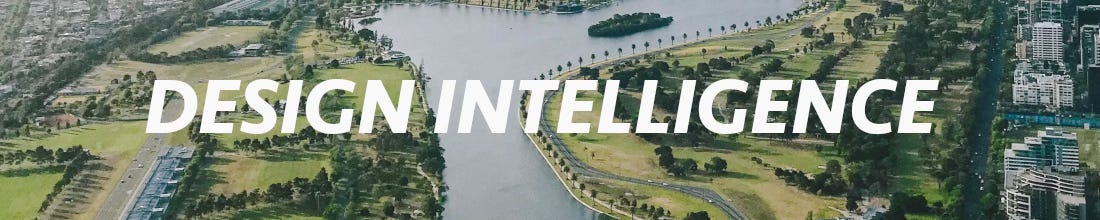
The idea: The swimmable city
Last year, a dozen river sites across the UK were given ‘bathing spot’ status, a government designation that brings with it a commitment to track and control water pollution levels. The move came in response to rising interest in wild swimming - swimming outdoors in natural bodies of water - over the past few years, which extends well beyond the UK. In the summer, Paris’ hosting of the Olympics brought with it a clean-up of the Seine, in part to enable water sports to be competed in it, but also to make the river publicly swimmable for the first time since 1923. Paris is famously walkable and has moved radically away from car-centrism this decade to embrace the concept of the 15 minute city. It’s now on its way to being a swimmable city too.
Other cities pushing for the idea include Melbourne, Copenhagen - which has made its harbours swimmable in recent years - and London, which aims to make the Thames swimmable by 2034. Some have come together under the Outdoor Swimming Society’s Swimmable Cities alliance, which has signatories from more than 49 cities, and last year launched a Charter of 10 principles to guide policy makers, designers and community leaders.
The swimmable city fits into a larger discourse that’s widening thinking on what access means in cities. It acts as a complement to the walkable or wheelable city, expanding the urban experience by expanding the modes of mobility it supports. It chimes with ideas around the child-friendly city, by viewing civic design from a perspective that is often wholly unconsidered: traversing a city by water changes our view of it. Waterways can also offer a way of building and maintaining the social connections that, particularly in cities and particularly in the 21st century, can be difficult to find and forge.
The swimmable city demands that we place higher standards on how clean our waterways must be - it insists that rivers should be swimmable, seas surfable, and all bodies of water liveable for more-than-human life too. There should be fish swimming in rivers as well as people. And beyond this, it invites us to reframe the relationship we have with water at a fundamental level.
Most obviously, in a swimmable city, public bodies of water should be easy to access, and water spaces should be venerated. This applies to rivers, of course, but also extends to spaces that are more artificial than natural. Private swimming pools have long functioned as individualist status symbols. Now, as communities turn again to building social infrastructure and ‘common wealth’, public-access pools and lidos are receiving new design attention. In 2021 the organisation POOL IS COOL opened Flow, the first public outdoor swimming pool to exist in Brussels for forty years, while NYC’s floating +POOL opens on the East River this year.
These spaces respond to water’s role for humans as a place of exercise, leisure and increasingly comfort, as city summers get hotter and more dangerous. They also emphasise play: the waterpark industry, established in the 1970s, is booming today. “Those components of water, sun, family, friends - they're very powerful when they're together,” says waterpark entrepreneur and designer Geoff Chutter. French theme park Futuroscope opened Aquascope, an expansive €57m immersive waterpark featuring colourful projections and choreographed water effects, last summer.
Running below the splashy investments in spaces for water is a deeper and more profound shift in our relationship to it. As water becomes more precious and hydrological cycles break down due to climate crisis, we are starting to acknowledge its role as a global common good more formally. New laws and legislation are moving toward acknowledging its inherent right to exist - aside from its usefulness to humans - by enshrining its rights. In Brazil last year, legal personhood was granted to the waves at the mouth of the Dolce river; in 2021, the Magpie River in Quebec gained rights including the right to flow and be safe from pollution. Environmental writer Robert Macfarlane, whose new book Is a River Alive? comes out this year, describes the growing map of rivers with rights as a “geography of hope”.
As all fans of the film Frozen 2 know, water has memory. As we start to cherish it more, can we attach value to being in water and with water, taking a relational approach instead of seeing water only as a resource to use, guard, and barter with? The future liveability of our cities, and our world, will depend in part on how we answer that call.
💬 My work
I gave a guest lecture at London College of Fashion this month on Branding in an Age of Breakdown. We looked at how fashion and design brands are responding to climate collapse, from radical redesign to controversial campaigns
🗒️ Research notes
Aalto University has launched the Nokia Design Archive, a website documenting the company's design development and advertising from 1995-2015. Among the 700 exhibits are some interesting hardware designs and memos from design ideation workshops
Robots dominated the headlines from CES this year, and the co-founder of iRobot is now developing a home robot ‘familiar’ that will focus on health and wellness functions. I’m fascinated by the potential of home robots and the psychology of robot pets, so I’ll be watching this company with interest
New legislation has come into effect in New York prohibiting the use of PFAs (forever chemicals) in clothing as countries increasingly crack down on these major pollutants
“Solar was the disruption of last decade. Batteries will be the disruption of this coming decade” says Tim Buckley in this impressive ABC News visualisation of the rise of solar energy around the world (including rooftop solarpunks in Pakistan)
Ed Hawkins, who made the famous Warming Stripes image of rising global temperatures, is part of a team who have created the new Air Quality Stripes - some of which tell a much more positive story of change
🪵 Interesting products
A New Field’s craft kits contain all the components needed to make something - apart from one natural material that you have to ‘forage’ for yourself, like a pinecone. Inspired by cake mixes, they can be made using only kitchen utensils
Date Everything! is a computer game in which you date furniture and home appliances, each of which has its own personality and story
Prepped, a brand concept by Robot Food, offers “food for the end of the world” with an aesthetic that aims to look “straight out of an apocalypse movie”