
Design Intelligence #31: Interestingly human
Handmade aesthetics, deep attention and valorised learning are emerging as narrative alternatives to AI inevitability

The idea: Humans in the loop
In the AI industry, the phrase ‘human-in-the-loop’ (HITL) describes an approach to developing and using AI systems in which humans review and intervene at key points within the data training or deployment process.
In AI discourse more widely, the term is usually interpreted less technically and more existentially. One of the central concerns people have about AI is if or when humans will leave the loop. Conversations that start at “what should a machine do and what should a human do?” always seem to circle back to: “what is human?” Instead of trying to tackle this compellingly unanswerable question, it can be more useful to ask: “what is interestingly human?” And for that question, at least, designers are already providing some answers, in the form of AI-free aesthetics.
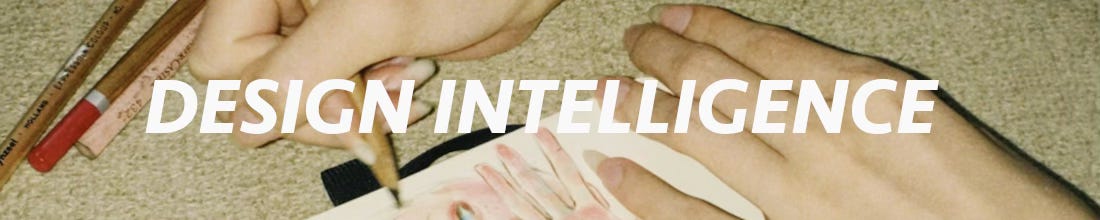
Some of the common elements of AI-free aesthetics include serif typography, hand-drawn illustrations and intentional visual imperfection. These artisanally human motifs function as a kind of protest to AI slop - as designers Studio Bassline have observed, “this isn’t just an aesthetic choice. It’s a response” - but they’re also an acknowledgement of the fact that the human eye is drawn to the less-smooth, the less-perfect, and the a-bit-weird. We are pattern-seekers, so disruptions in the pattern compel us to pay attention: a study published in 2019 found that mathematically simpler images retain a viewer’s attention less well, while complexity demands “perceptual sensitivity”.
Deep attention is growing in importance beyond aesthetics too. Culturally, it’s become fashionable to present semiotic cues of intelligence, or more specifically, to look as though you read books and have informed opinions. In London, the undisputed leader in status symbol tote bags is Daunt books. Its distinctive shoulder bags create the appearance of being “disgustingly educated”, at a time when having niche interests has become a lifestyle aspiration (see also: the entire dark academia subculture). ReMarkable’s paper-like tablets work similarly: they communicate the idea that the person using them has an interesting mind and cultured things to do.
Live events that valorise in-person presence and learning are mushrooming around the world, including Lectures on Tap, with its pints, professors and “note taking vibes”, and schools like the Strother School of Radical Attention in Brooklyn. Intelligence is becoming not just a route to culture but a culture in itself. Digital technology can derail or enhance it. Depending on how we choose to use it, social media can be a feed to zone out to or a font of knowledge: thanks to charismatic communicators on TikTok, lots of people now have decent understandings of subjects they wouldn’t have encountered otherwise. As Dazed Studio wrote earlier this year, for young adults, “Information is no longer passively received but something to actively participate in.”
Writing in Aeon, Australia-based university librarian Carlo Iacono makes a related point. Reading rates appear to be falling, but modes of access to knowledge keep growing. “Each mode [documentaries, newsletters, video essays, data visualisations, podcasts] contributes something the others cannot. This isn’t decline. It’s expansion.”
The most astute AI companies are making themselves part of this expansion. Chatbots have made assemblages of information very easy to obtain, but human thinking is still required. As part of its Keep Thinking branding, the marketing team for Anthropic’s Claude runs pop up events where people wait patiently in line to acquire cups of coffee, good reading lists, and ‘thinking’ caps.
People with a vested interest in a more automated, less intellectually curious future will position that future as inevitable. No future is inevitable. How long will humans be in the loop for? For as long as we consider our intelligence to be important. “Become a person with an interesting mind,” urged Ellen McGirt, editor in chief at Design Observer, in a recent op-ed. “Claim the human experience, with all its foibles and false starts. Try the new thing, cook the food, watch the film, read the book, collect weird shit, talk to someone you’re wary of, pick up a pencil, and draw. Take the long road, and not just because it will make you more marketable. But because it’s the better path.”
🗞️ My work
One of the reasons I’ve been poring over AI semiotics so much lately is that I’ll be a guest lecturer at Dutch Invertuals’ AI Academy, taking place this summer, which will conduct design inquiry into the impact of AI on creativity, imagination and society
I’m on the latest episode of The Mindset Economy podcast talking about Designing Hope
And I went to speak to the MarketingKind community too
🗒️ Research notes
The green transition is showing small but highly significant signs of actually starting to be a transition. New reports confirm that China’s fossil fuel emissions from energy and industry dropped in 2025, by 0.3%, even as energy consumption rose by 3.5%. Renewables met 40% of demand, led by solar energy, causing coal use to drop slightly. If this momentum can be maintained, and if other countries (and industries) follow this lead, meaningful emissions reduction will happen
Consumer electronics brand HP is working with recycling company Mint Innovation to extract the copper from its old computers and printers and remanufacture it into its new products, creating an industry-first closed-loop process
Following news of Meta’s plans to add facial recognition to its AI glasses (also now known as “pervert glasses”), designs of resistance are emerging. Nearby Glasses is a new app that notifies you when smart glasses are detected nearby so that you can “act accordingly”
More protest art: Times New Resistance is a free custom font released by graphic designer Abby Haddican to “autocorrect the autocrats”. The font automatically changes some words as they’re typed: “Trump” becomes “Donald Trump is a felon” and “ICE” becomes “the goon squad”
New feature film Earth’s Greatest Enemy looks at the environmental impact of the Pentagon, “the world’s biggest - and most unaccountable - polluter”
📱 Watching
Brian Eno interviewed by Zane Lowe for Apple: “You really ought to be the shepherd of your own attention. You can’t let that be stolen from you.”